
Mosquito Ecology and Behavior
The "Vector"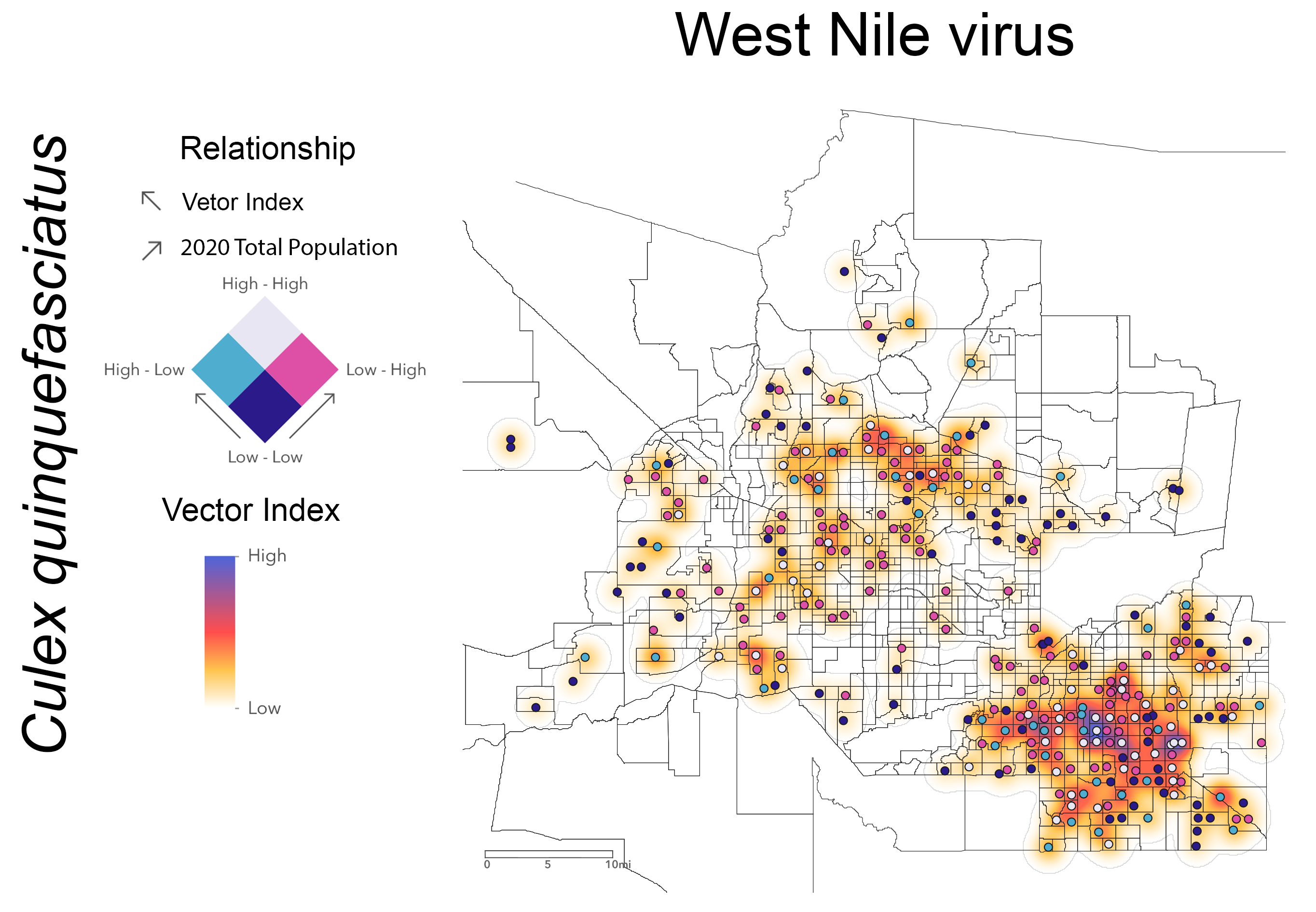
Why Mosquito Ecology and Behavior?
Pathogen transmission does not occur in a vacuum; it is the result of a complex interplay between humans, animals, and the environment. Taking a one health perspective, we recognize that the health of people is inextricably linked to the health of the animals and the shared ecosystems they inhabit.
In the specific case of mosquito-borne diseases, the environment acts as a primary driver of risk. To manage diseases like dengue or West Nile, we must first understand the ecological and behavioral dynamics of the mosquitoes that transmit them. This involves answering critical questions such as: Which species are present in a given area? Are changing climates pushing these vectors into previously unaffected territories? How does their abundance fluctuate with the seasons? When and where are mosquitoes interacting with human and other hosts? By investigating these underlying mechanisms, our research provides the biological context necessary to understand the epidemiology of mosquito-borne diseases.
Research Topics
- Spatial Drivers of Mosquito Relative Abundance. The CEPH Lab investigates how environmental and weather variables determine the distribution and density of various mosquito species. This allows us to characterize the spatial landscape in which mosquito-borne pathogens spread.
- Mosquito Seasonality. Seasonal trends in mosquito relative abundance are highly heterogeneous across species and locations, including within the US. Our research investigates the environmental determinants of these trends, which are key for risk assessment and public health planning.
- Mosquito Diel Activity Patterns. Human exposure to mosquito-borne pathogens is driven by the temporal overlap between human and vector activity. Our research aims to identify the environmental drivers of diel mosquito behaviors (e.g., blood-seeking, resting).
Approach
We analyze mosquito surveillance and field trial data across diverse ecological contexts using a suite of analytical approaches. Our work primarily leverages statistical modeling, including spatial modeling to map species distribution, signal decomposition techniques to disentangle seasonal trends vs. long-term patterns, and regression analyses and machine learning to identify predictors.
Impact
- Public Health Decision Support: Provide scientific evidence to support mosquito surveillance efforts and control operations to our partners, such as the Miami-Dade County Mosquito Control, Maricopa County Environmental Services, Greater Los Angeles County Vector Control District, and New Orleans Mosquito, Termite and Rodent Control Board.
Funding
- Our work on mosquito ecology and behavior is primarily supported by the NSF.
References
-
Wilke ABB, Damian D, Litvinova M, Byrne T, Zardini A, Poletti P, Merler S, Mutebi JP, Townsend J, Ajelli M.
Spatiotemporal distribution of vector mosquito species and areas at risk for arbovirus transmission in Maricopa County, Arizona. Acta Tropica. 2023;240:106833.
-
Wilke ABB, Mhlanga A, Kummer AG, Vasquez C, Moreno M, Petrie WD, Rodriguez A, Vitek C, Hamer GL, Mutebi JP, Ajelli M.
Diel activity patterns of vector mosquito species in the urban environment: Implications for vector control strategies. PLoS Negl Trop Dis. 2023;17(1):e0011074.